


Understanding the Brain: Functions by Lobe Explained

Updated: Jul 22
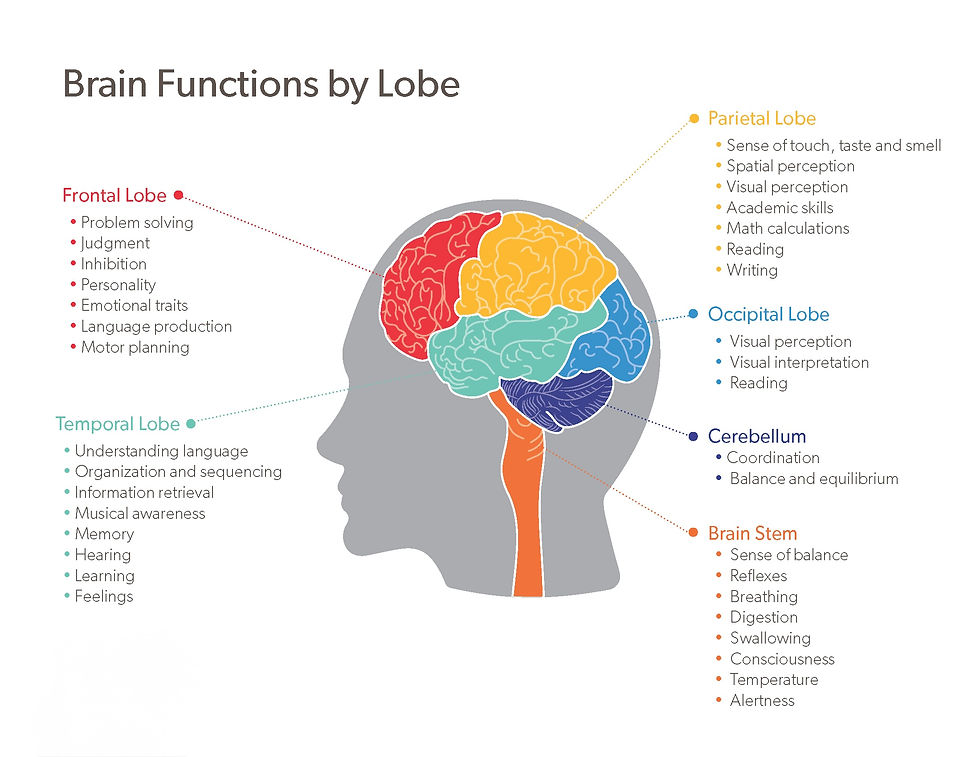
The human brain is one of the most complex and fascinating organs in the body. It controls everything we do - from breathing and movement to decision-making, emotions, and memory. The image above provides a simplified, colour-coded breakdown of the brain’s key regions and their functions. While it separates the brain into distinct areas, it’s important to remember that these regions work together constantly.
In this article, we’ll explore each part of the brain in detail, bringing the diagram to life with real-world examples and practical insights.
The Frontal Lobe: The Brain’s Executive Centre
The frontal lobe sits at the front of the brain and is responsible for higher-level thinking and behaviour. It’s what allows us to function as organised, socially aware individuals.
What does it do?
The frontal lobe is involved in:
Decision-making and problem solving
Judgement and impulse control
Personality and emotional regulation
Speech production
Planning and organising movement
Everyday examples
Think about how often you rely on this part of your brain:
Deciding what to say in a meeting
Planning your day or managing your time
Stopping yourself from reacting impulsively
Speaking clearly and forming sentences
Choosing appropriate behaviour in social situations
Why it matters
When the frontal lobe is damaged—such as through a brain injury—changes can be dramatic. Someone may appear like a “different person,” showing impulsive behaviour, poor judgement, or lack of motivation. These changes are neurological, not intentional, which is a key point in understanding behaviour after injury.
The Parietal Lobe: Making Sense of the World Around You
Located at the top and back of the brain, the parietal lobe processes sensory information and helps us understand spatial relationships.
What does it do?
It is responsible for:
Interpreting touch, temperature, and pain
Spatial awareness and positioning
Visual-spatial processing
Supporting reading, writing, and maths
Everyday examples
You use your parietal lobe when you:
Judge how far away something is
Walk through a room without bumping into furniture
Write neatly on a page
Solve a maths problem
Feel whether something is hot or cold
Why it matters
Damage to this area can cause difficulties that aren’t always obvious at first. For example, someone may ignore one side of their body (a condition called spatial neglect), struggle with basic maths, or have trouble coordinating movements. These challenges can significantly impact independence.
The Temporal Lobe: Memory, Language, and Emotion
The temporal lobe sits on the sides of the brain, near the ears, and plays a key role in how we process sound, language, and memory.
What does it do?
Its functions include:
Understanding spoken language
Processing sound and hearing
Storing and retrieving memories
Supporting learning
Managing emotional responses
Recognising music and rhythm
Everyday examples
This lobe is active when you:
Follow a conversation
Remember someone’s name
Recognise a familiar voice
Learn new information
Feel emotional when hearing a particular song
Why it matters
Damage to the temporal lobe can affect communication and memory. Someone may hear words but struggle to understand them, or they may forget recent events. Emotional responses may also change, which can be confusing for both the individual and those around them.
The Occipital Lobe: The Visual Processing Hub
Positioned at the back of the brain, the occipital lobe is dedicated almost entirely to vision.
What does it do?
It handles:
Visual perception (seeing shapes, colours, and movement)
Interpreting visual information
Supporting reading
Everyday examples
You rely on the occipital lobe to:
Recognise faces
Read text
Identify objects
Notice movement around you
Why it matters
Damage to this area doesn’t just affect eyesight—it affects how the brain interprets what the eyes see. A person might be able to see clearly but still struggle to recognise objects or read, highlighting the difference between vision and perception.
The Cerebellum: Coordination and Precision
The cerebellum sits underneath the main part of the brain and is essential for smooth, coordinated movement.
What does it do?
Its main roles include:
Coordinating movement
Maintaining balance
Fine-tuning motor skills
Supporting motor learning
Everyday examples
The cerebellum is at work when you:
Walk steadily
Catch or throw a ball
Ride a bike
Write or type
Keep your balance while standing
Why it matters
If the cerebellum is damaged, movements can become unsteady or shaky. Tasks that were once automatic—like walking or buttoning a shirt—may require significant effort and concentration.
The Brain Stem: Keeping You Alive
The brain stem connects the brain to the spinal cord and controls vital functions that keep you alive.
What does it do?
It regulates:
Breathing
Heart rate
Reflexes (e.g. swallowing, coughing)
Consciousness and alertness
Body temperature
Everyday examples
You don’t have to think about:
Breathing while you sleep
Swallowing food
Waking up in response to noise
Maintaining your body temperature
That’s your brain stem at work.
Why it matters
Because it controls essential life functions, damage to the brain stem is extremely serious and can be life-threatening. It may affect breathing, consciousness, and the ability to swallow safely.
How the Brain Works Together
Although we’ve explored each area separately, the brain rarely works in isolation. Almost every task involves multiple regions working together.
A simple example: Making a cup of tea
Frontal lobe: Planning and decision-making
Parietal lobe: Handling objects and judging distances
Temporal lobe: Remembering the steps
Occipital lobe: Seeing what you’re doing
Cerebellum: Coordinating movement
Brain stem: Maintaining breathing and alertness
This interconnected system is what allows us to function smoothly in everyday life.
This visual guide to brain function is a powerful reminder of how specialised yet interconnected our brains are. Each lobe has its own role, but it is their collaboration that enables us to think, move, communicate, and experience the world.
Understanding these functions is particularly important in contexts such as brain injury awareness, where changes in behaviour, movement, or communication can often be traced back to specific areas of the brain. By linking structure to real-life function, we gain a clearer, more compassionate understanding of how the brain shapes who we are.
If you would like tailored advice or want to book health and social care training for your organisation, then visit www.traindirect.co.uk to learn more or contact our team to discuss your training requirements.
tel. 0330 223 5596,
email. info@traindirect.co.uk
or complete the form on our homepage to request a call back.



Comments